

Aerofoils™: Shelf Edge Technology for Open Refrigeration Cases
Shelf-edge Airflow Control for More Efficient Open Refrigeration
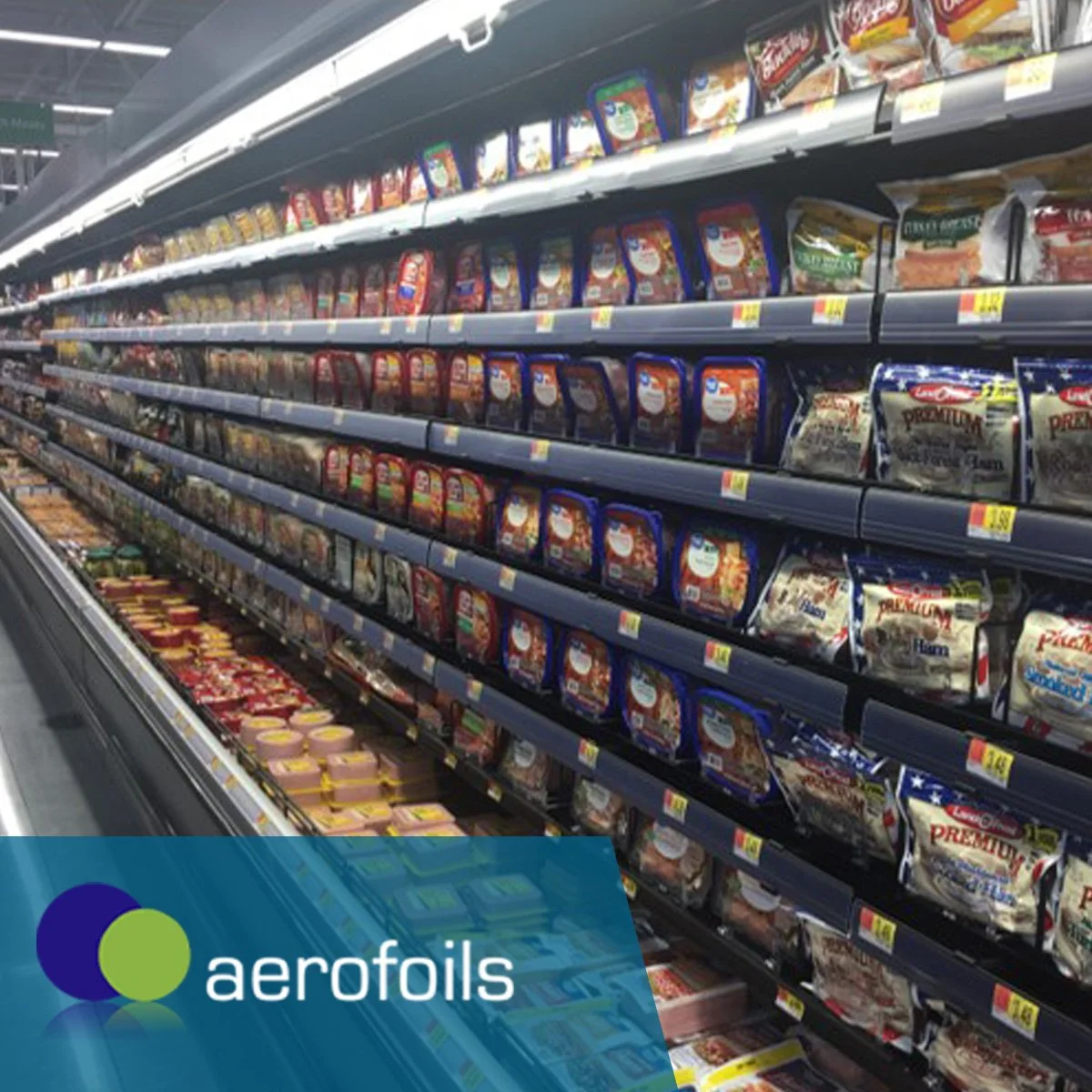
Open refrigerated display cases depend on a stable cold-air curtain to keep products at temperature and energy use under control. In real stores, that curtain breaks down at the shelf level.
As air passes over shelf fronts, price rails, and product edges, turbulence is introduced into the airflow. This disrupts the air curtain before it reaches the return grille, allowing warm air into the cabinet and cold air to spill into the aisle. The impact is higher refrigeration load, uneven temperatures between shelves, and reduced shopper comfort.
Aerofoils™ are designed to address this exact point of failure.
By stabilising airflow at the shelf edge, this cutting edge supermarket energy technology helps maintain a coherent air curtain throughout the height of the cabinet, improving efficiency and performance without changing how cases are merchandised or shopped.
What are Aerofoils™?
Aerofoils™ are patented shelf-edge airflow guides for open refrigerated display cases.
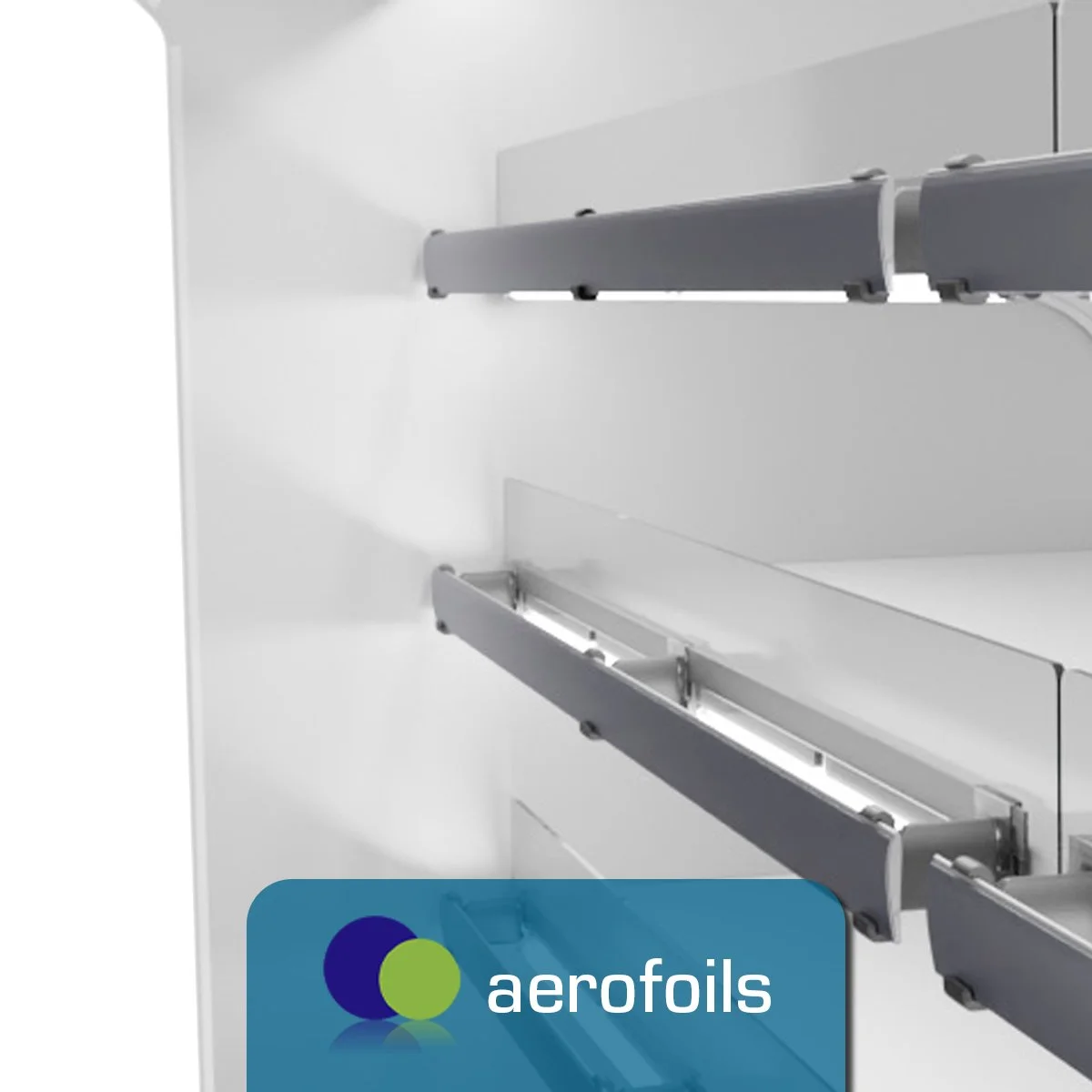
Fitted to the front edge of each shelf, they stabilise the cold air as it moves down the cabinet.
By shaping airflow at the shelf level, Aerofoils™ reduce turbulence caused by products and shelf fronts, helping the air curtain remain coherent from top to bottom.
They work with the cabinet’s existing airflow, without changing the structure of the fridge or adding physical barriers.
Aerofoils™ are a low-intervention retrofit.
They install quickly, require no power or maintenance, and preserve full product visibility and open access. As part of the Invisidoor™ open refrigeration solution, they provide precise airflow control at the point where the air curtain is most vulnerable.
Fast-Fit Aerofoils. Instant Energy Savings
Our Aerofoils are designed for fast, tool-free installation fitted in seconds without de-merchandising or interrupting store operations. A seamless upgrade that delivers energy savings from day one.
How Aerofoils™ works
Each Aerofoil is profiled using advanced computational fluid dynamics (CFD) to guide the cold air smoothly past the shelf edge. By reducing shear and turbulence at every shelf level, the airflow remains more laminar as it descends through the cabinet. This prevents premature mixing of warm and cold air and helps maintain the integrity of the air curtain across the full height of the case.
Stabilising the air curtain shelf-by-shelf delivers measurable performance gains:
More cold air is retained inside the cabinet
Less warm air is drawn into the refrigeration system
Product temperatures remain more consistent from top to bottom
The refrigeration load on the cabinet and central plant is reduced
Because Aerofoils™ work with the fridge’s existing airflow and fan systems, these improvements are achieved without increasing energy input, adding moving parts, or introducing new points of failure. The result is quieter, more efficient open refrigeration, warmer aisles, and improved food quality.
What our Clients are Saying
Aerofoils™ vs. retrofitting glass doors
Aerofoils™ |
Doors |
|
|---|---|---|
Customer experience |
Preserves open-fronted browsing and effortless access. |
Creates a physical barrier, reduces visibility and slows down the shopping experience, which is proven to reduce purchasing behaviour in multiple categories. |
Energy & temperature performance |
25–38% energy savings in real-store conditions, with more stable product temperatures. | Independent research shows real-store savings fall significantly below ISO laboratory figures, especially during peak trading. |
Operational cost & maintenance |
No hinges, seals, heaters or moving parts. No maintenance. | Require ongoing upkeep, cleaning, adjustments and parts replacement, increasing the total cost of ownership. |
Trading & merchandising |
Keeps the case fully open, supporting impulse purchases, category uplift and fast restocking. | Slows down merchandising, reduces the speed of the shop, and adds operational friction. |
Compliance & eco-labelling |
Recent testing shows that open cabinets retrofitted with Aerofoils can move from an E-Rating to a C-Rating under EU eco-labelling criteria, reflecting a substantial improvement in real-store energy performance without the need for doors. | Can achieve similar regulatory ratings when tested, though actual performance in trading conditions often varies based on opening frequency and system wear. |
Technology approach |
Precision-engineered airflow technology, informed by CFD and real-store performance data, designed to optimise efficiency without physical barriers. | A legacy refrigeration approach based on mechanical enclosure rather than airflow control, with higher cost, ongoing maintenance, and performance that varies in live trading environments. |
Commercial Benefits & ROI
Retail leaders are looking for solutions that deliver measurable benefits without operational compromise. Aerofoils meet these demands by improving the three core pillars of refrigeration performance: energy, temperature and trading.
Because Aerofoils are a passive and economic technology, payback is often under 18 months, even in low-energy-cost markets.
Energy Savings
Aerofoils reduce the refrigeration load by making the air curtain significantly more efficient. Real-store deployments typically deliver:
25%–38% reduction in cabinet energy consumption
Additional reductions in central plant load
Lower maintenance and fewer engineering callouts
An average aisle temperature increase of 6°C

Payback
Because Aerofoils are passive and economical to retrofit, payback is often under 18 months, even in low-energy-cost markets.
Food quality & waste reduction
Improved airflow control:
Reduces hotspots
Supports consistent temperature bands
Extends shelf life and reduces shrinkage in sensitive categories such as meat, dairy and produce
Sales & trading performance
Aerofoils protect what retailers value most about open cases:
Barrier-free access
Faster, more enjoyable browsing
Better product visibility
No customer drop-off associated with door-opening friction
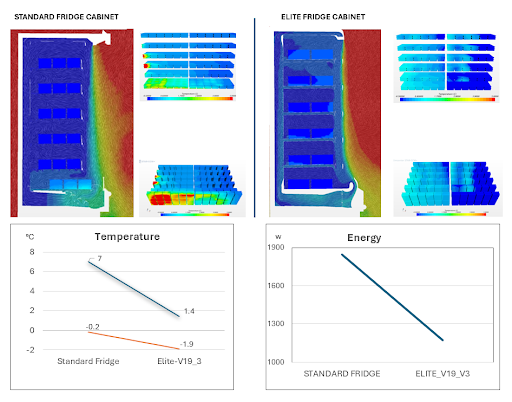
Aerofoils retain heat far better than fridge cabinets without them
Ready to cut energy use without adding doors?
Aerofoils™ are already helping major retailers improve energy performance, stabilise temperatures and protect sales, all while keeping refrigeration open-fronted.
See what Aerofoils could save across your estate.
-
Open cases use a continuous downward “air curtain” of chilled air to separate the cold interior from the ambient store environment. When this curtain weakens, due to turbulence, shopper movement or draughts, warm air enters the cabinet and cold air spills into the aisle, increasing energy use.
-
Aerofoils stabilise and strengthen the air curtain so that cold air stays inside the case. This reduces energy consumption, improves product temperatures and eliminates cold-aisle discomfort, without adding a physical barrier.
-
Real-store results typically show 25–38% energy savings on open-fronted cabinets, with additional reductions in central plant load.
-
Yes. Aerofoils are designed for fast, low-disruption retrofit across most major open-case models. Installation can usually be completed during trading hours.
-
In many real-store environments, Aerofoils deliver comparable or stronger energy and temperature stability, without the behavioural sensitivities associated with doors (door-opening frequency, seal wear, maintenance) or the trading barriers they introduce.
-
No. Aerofoils preserve the full open-front format of the cabinet, maintaining visibility, ease of access and merchandising flexibility.
-
By preventing warm-air ingress and reducing hotspots, Aerofoils help maintain consistent temperature bands across the cabinet, supporting longer shelf life and improved food quality.
-
Yes. Aerofoil Energy provides specialist aerofoil profiles and components such as Aeromirror for meat displays and sloped-shelf formats to ensure consistent airflow control across all cabinet types.
-
None. Aerofoils is a fully passive, non-electrical system with no hinges, seals or moving parts. Cleaning is performed exactly as it would be with any standard shelf-edge.
-
Yes. Aerofoils has recently enabled several previously E-rated open-case models to achieve a C-rating under the European eco-labelling scheme, demonstrating strong regulatory alignment without the need for doors.
-
No. Aerofoils are designed to be invisible to customers, improving their experience by creating warmer aisles and easier access to chilled products.
Frequently Asked Questions
Need more information?