
The price of closing the fridge door in a store
What is the impact of supermarket fridge doors on shopper behaviour? How relevant is a 2017 pilot study today? In this blog, we revisit the findings of the 2017 study in the context of present-day shopper behaviour, to judge how doors might be influencing sales in 2026.
Fridge Doors – The results of the 2017 study
22% fewer shopper interactions with products
29% reduction in chiller aisle shoppers going on to make a purchase
13% fall in grab-and-go sales
Remarkably, there are very few studies of how supermarket fridge doors affect shopper behaviour. But in 2017, SBXL conducted detailed research into the issue and published their results. The findings were stark and addressed the key question head on: does putting doors on supermarket chillers reduce sales?
The 2017 study assessed how fridge doors affected how people interacted with food products on the shelves. The execution of the study was impressive, deploying in-store filming of several chilled aisles and cross-referencing behavioural traits across a database of more than 65,000 shoppers. These were its findings:
How people buy
The study found that 77% of shoppers used a trolley, 13% a basket and 10% used neither.
When shopping from chillers fitted with doors, only 29% of shoppers with no basket or trolley, and only 68% of shoppers with a basket, opened fridge doors. Together these shoppers accounted for a mere 23% of total shoppers.
More concerning, of the shoppers with trolleys, which made up the vast majority of all shoppers (77%), only 3% opened the fridge doors whilst shopping the chiller aisles.
The study clearly demonstrated a general reluctance of shoppers to open fridge doors. Moreover, this reticence to shop cabinets with doors was more prevalent among those pushing trolleys who made up most of the shoppers in the chiller aisle.
Pack reading

The study found that the biggest change to shopper behaviour was in pack reading. They recorded that without fridge doors 31% of shoppers read pack labels of products, but in stores with fridge doors this figure dropped to just 9% – a reduction in pack reading of 22%. But why is this important?
The study showed that whilst pack-reading didn’t always result in a sale, 10% more chilled food buyers were pack-readers. By extension therefore, inhibiting pack reading by placing a barrier in front of the customer was likely to have a tangible negative impact on sales and product exploration and understanding.
In particular, the study highlighted that sales of new food products were uniquely and negatively impacted by fridge doors, because purchases of new products rely heavily on shoppers being able to read packs.
These figures date from 2017, but recent studies show that pack reading has significantly increased. In 2025, a study by NSF found that:
“76% of UK adults read food labels before purchasing… rising to 82% among 18–34-year-olds…
45% pay more attention to food labelling compared to five years ago”.
A second report by Ingredion found that:
“The most dramatic, statistically significant increase reported in this year's study is that consumers are checking ingredient and nutrition labels, both reported at 43%, up from 36% in our prior study”.
Since pack reading is now even more important today than in 2017, it’s no surprise that fridge doors are becoming a significant obstacle to purchasing decisions of chilled food products.
Buyer conversion
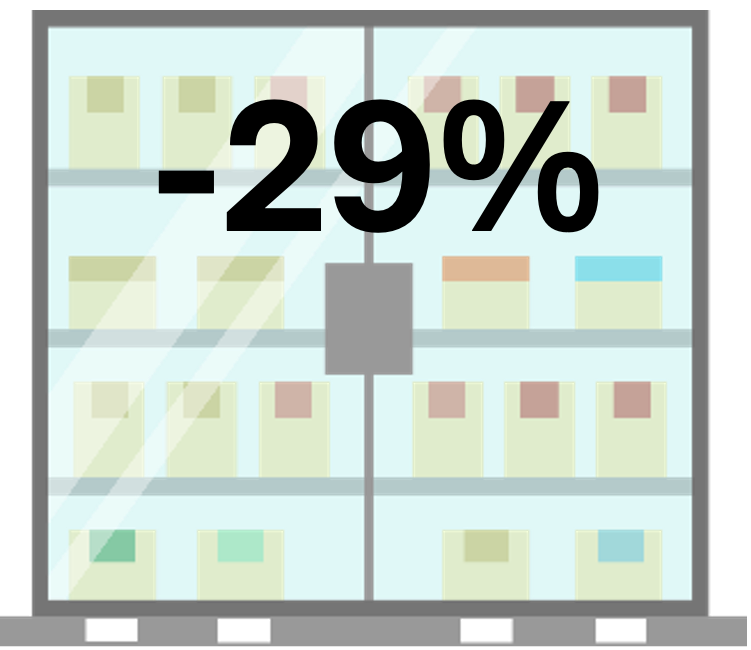
The 2017 study described this as ‘The Big One’: What impact do fridge doors have on the conversion of shoppers into buyers in chilled categories?
The study showed that only 1 in 2 shoppers visiting chilled aisles with doored cabinets went on to make a purchase, a decrease of 29% compared to aisles with open-fronted cabinets.
Once again, given the increased importance of label reading by shoppers in 2026, this fall in purchasing decisions has likely deteriorated further.

Drilling down, the study also investigated whether there were differential impacts depending on product type. It found that Grab & Go sales suffered more acutely, having decreased by 13% when chillers had doors fitted.
Cold aisle syndrome
The original study set out to examine whether fridge doors might even increase sales by making chiller aisles warmer. In this regard it found no evidence to support such a theory. And in any event, the problem of cold aisles has been addressed by other technologies. For example, the study cited Aerofoils being adopted by Sainsburys, who in common with several other leading UK supermarkets, reported that Aerofoils had solved the problem of cold aisles by warming them by an average 5.5°C – from a chilly 13°C to a comfortable 19.5°C. So if a retailer is seeking to address cold-aisle syndrome specifically, it now has access to a much more cost-effective, barrier-free and customer-friendly solution.
The upshot
The 2017 study showed that fridge doors had profound, negative effects on the customer journey with consequent impacts on the sales of chilled foods. The study also cited the (then) new Aerofoil shelf-edge technology, which had already closed the energy gap between open fridges and doored fridges. It concluded by posing the question ‘What’s Next for Fridges?’, postulating that it would be ‘more efficient, environmentally-friendly fridges that don’t have doors…’
Fast forward to 2026 and today’s technologies make open-fronted fridges as energy efficient as those fitted with doors, and at a tiny fraction of the whole-life cost. Therefore, the energy argument in favour of fridge doors is no longer credible, and so the disadvantages to the customer journey and to sales can no longer be justified on any grounds.
Is 2026 the year that open fridges become the new standard in chilled grocery retailing? If history is anything to go by, the answer to this question is ‘Yes, absolutely’.
Sources:
https://www.sciencedirect.com/science/article/abs/pii/S0148296318301413