
Eco-labelling, open refrigeration, and legal compliance: What retailers need to know
Are fridge doors about to become legally mandatory across Europe? Many retailers think so. Refurbishment plans are being rewritten. Open cabinets are being phased out. All based on speculation about what regulation might do next.
The issue is they're acting on assumptions, and not the facts.
The confusion stems from how energy labels work and how speculation about future regulation is being treated as certainty. Open refrigeration has been particularly affected. The belief that open cabinets are no longer compliant is already influencing investment decisions across Europe, even though open refrigeration remains fully legal under current EU rules.
EU eco-labelling and Ecodesign frameworks set energy performance thresholds, but they do not prescribe cabinet formats. At the same time, laboratory testing produces results that look very different to what happens in real stores, making doors appear far more efficient than they are in real stores.
This article addresses the most common misconceptions around open refrigeration and EU compliance. It clarifies the current legal position, explains how eco-labelling results are generated, and outlines what retailers should actually be doing now.
Key Takeaways:
Fridge doors are not legally required under current EU EcoDesign or Energy Labelling rules. Compliance is based on energy performance, not cabinet format.
Open refrigeration remains fully compliant, with the next legislative review scheduled for 2028.
Energy labels are shaped by ISO 23953-2 laboratory testing, which favours doored cabinets and overstates their real-world performance.
Cabinets fitted with Invisidoor technology are already listed with a C rating, compared to E-rated equivalents without it. To put that into context, the vast majority of doored cabinets (around 87%) are only D or C rated, meaning that some open cabinets have already achieved the same, or higher, rating than those with doors.
Retailers have time to make evidence-led, flexible decisions rather than reacting to assumed regulatory change.
Are fridge doors a legal requirement in the EU?
No, absolutely not. Fridge doors are not a legal requirement in the EU.
While this assumption is widespread across the market, fridge doors are not currently required under EU law. Regulation in this area is governed by EU EcoDesign Directives and Energy Labelling regulations, which set energy performance thresholds from A to G. These thresholds apply to all refrigerated display cabinets, open or doored.
Compliance depends on whether a cabinet meets the energy threshold for its rating category. Cabinet format doesn't determine compliance.
If you’re wondering where the false assumption comes from, we think it’s mostly from speculation about future legislative change, particularly around the potential removal of lower energy ratings. At present, there is no confirmed direction on what happens next.
What we do know:
G-rated cabinets were phased out in 2023
F is currently the lowest permitted rating
The next formal review of eco-labelling legislation is scheduled for 2028
There is no defined plan for further category removals, but it is likely that F and E-rated cabinets will be withdrawn at some point.
It is worth another reminder - the majority (87%) of all doored cabinets listed on EPREL are D and C rated - meaning it is highly unlikely that these ratings will be removed any time in the near future. This also means that open cabinets which have, or do, achieve ratings of D-A are equally as unlikely to be removed.
Under the current framework, open and doored cabinets are assessed in the same way. Provided the relevant energy thresholds are met, both formats remain legal for sale and use across the EU.
↪ Related reading: Fridge doors: How much energy do they really save?
What “legal and compliant” means for open refrigeration today
Questions around legality often come up because eco-labelling gets discussed alongside future regulatory reviews. This creates uncertainty about whether open refrigeration remains acceptable under current rules.
It does.
From an EU-wide regulatory standpoint, open refrigeration is completely compliant today. There are no changes to this position ahead of the 2028 review.
Compliance is assessed through the existing EcoDesign and Energy Labelling framework. The focus is on whether a cabinet meets the required energy performance threshold for its rating category. Cabinet format doesn't determine compliance.
Open refrigerated display cabinets that meet the relevant energy threshold remain fully legal for sale and use across the EU.
Why open cabinets often appear worse on energy labels
Open cabinets often appear to perform worse on energy labels than doored cabinets due to the ISO 23953 testing standard, which does not reflect cabinet performance in real store conditions.
The ISO 23953 standard favours doored cabinets and penalises open cabinets. This creates a distorted comparison.
Laboratory testing under ISO 23953 uses Climate Class 3 conditions: 25°C, 60% relative humidity, with specified cross-airflows. Under these conditions, warm and humid air is continuously blown across the front of the cabinet.
For open cabinets, this airflow disrupts the cold air curtain and increases energy consumption during the test. Doored cabinets are largely shielded from this effect, which results in lower measured energy use under laboratory conditions.
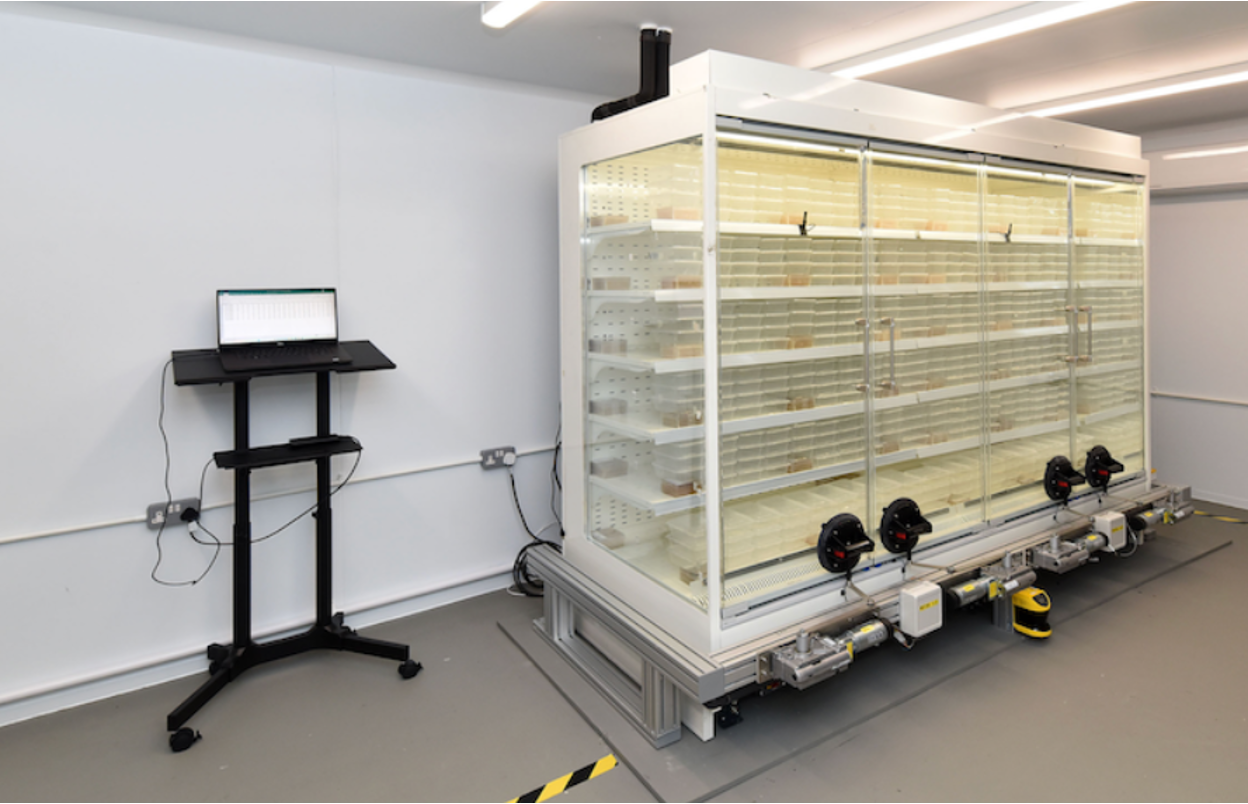
Aerofoil Energy’s in-house test chamber
This means that:
Open cabinets appear to consume more energy
The efficiency of doors is overstated
Energy labels reflect a comparison that does not align with store environments
Laboratory testing can produce claims of up to 60% energy savings for cabinets fitted with doors. When cabinets are monitored in live store conditions, real-world data typically shows energy savings of 20% to 30%.
Another factor is door usage. The number of door openings per hour in ISO 23953 laboratory testing is significantly lower than the frequency observed in real stores. This further increases the gap between laboratory results and in-store performance.
When tested in live trading environments, cabinet performance differs substantially from laboratory outcomes, particularly for open refrigeration.
What is actually changing in 2027 and what retailers are worrying about unnecessarily
At present, there are no scheduled reviews or confirmed changes to eco-labelling or Ecodesign legislation in 2027.
The next formal review of legislation is planned for 2028. Until that point, there is no published guidance on changes to energy thresholds, rating categories, or cabinet format requirements.
Many of the concerns currently influencing refrigeration decisions are based on assumptions rather than defined regulatory action. There is no indication that existing compliant cabinets will be affected before the 2028 review.
Retailers should distinguish between confirmed regulation and anticipated change, particularly when making long-term investment or refurbishment decisions.
What has already been proven with Invisidoor technology
Testing carried out using Invisidoor technology has already delivered a measurable change in energy labelling outcomes.
Some cabinets tested with Invisidoor technology are listed on the EU Energy Labelling scheme with a C rating. The same cabinet, without Invisidoor technology, is currently listed as E-rated. More models will be tested in 2026. Many more will increase their ratings from F-E to D-C, and it is likely that some, depending on what rating they began at, will achieve B-rating.
This outcome is significant from a compliance perspective. A very large number of refrigerated cabinets fitted with doors are only D-rated, which means a C-rated open cabinet remains competitive within the current energy labelling framework.
It also has implications for future regulatory resilience. Category C is considered unlikely to be removed under any potential review of eco-labelling legislation in 2028. Open cabinets that achieve this rating remain a future-proofed option under the current framework.
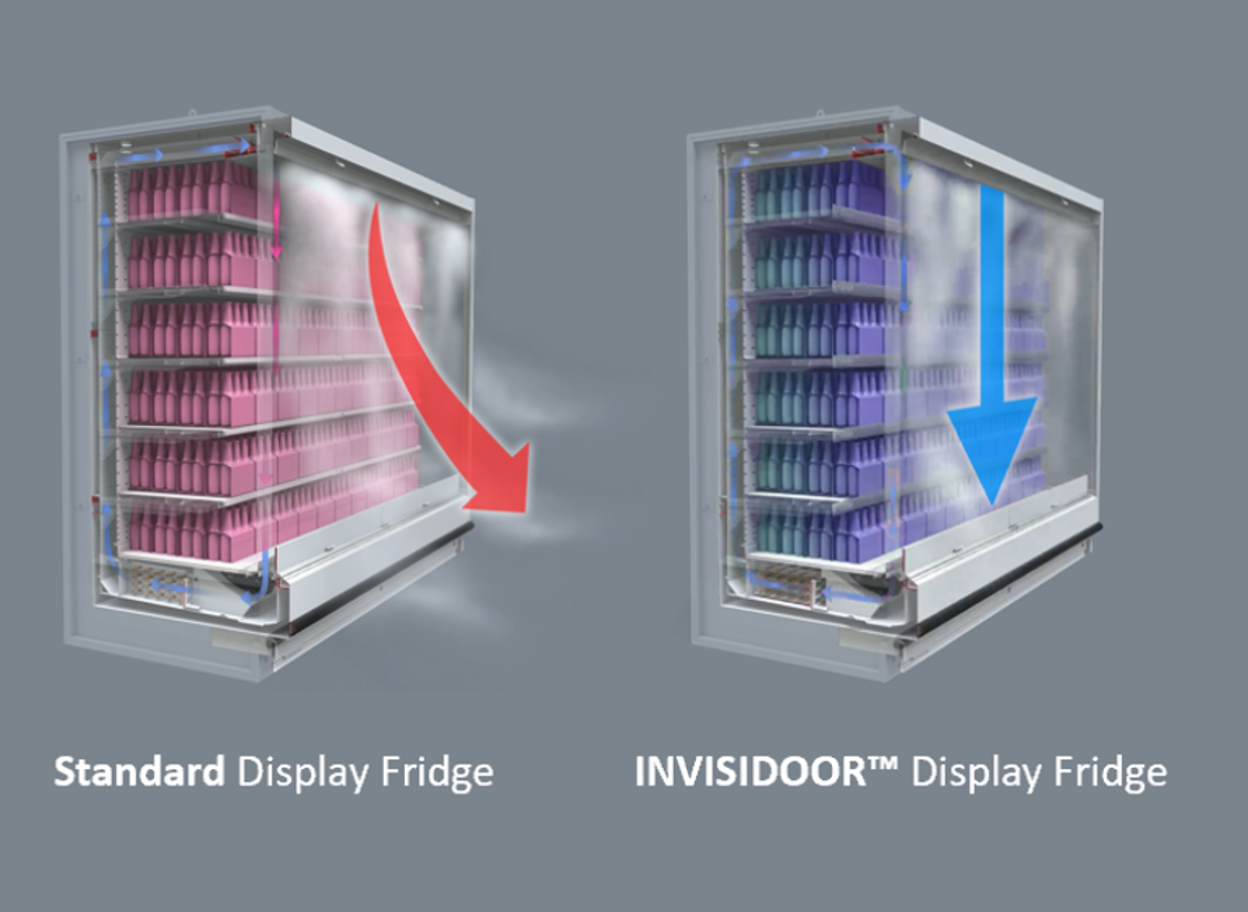
Invisidoor technology eliminates cold air loss from an open-fronted cabinet
This does not suggest all open cabinets will achieve the same rating. It demonstrates what has already been achieved under defined test conditions and provides evidence that open refrigeration can meet higher energy performance thresholds.
📕Read more: Invisidoor™ for open refrigerated display cases: Cutting energy without doors
Why this should be viewed as a journey rather than a one-off result
The first compliant open cabinet fitted with Invisidoor technology is part of a wider progression, not an isolated outcome.
In store conditions, open cabinets fitted with Invisidoor technology can deliver energy performance comparable to doored cabinets. This includes comparable energy savings, alongside the additional benefit of warmer aisles and barrier-free open case shopping for customers.
Ongoing testing and continued collaboration with cabinet OEM partners remain central to this work. Further progress will be driven by additional validation across different cabinet types and store environments.
For retailers, this means open refrigeration with Invisidoor technology should be considered a developing option that aligns energy performance with customer experience, rather than a single result tied to one cabinet configuration.
Best practice: how retailers should act now
The key point for retailers is this: there is time.
Current regulation allows retailers to plan based on evidence rather than reacting to assumptions about what legislation might do in the future. A sensible approach now focuses on keeping options open and decisions grounded in real performance.
There are three practical steps retailers should be taking.
1. Work with cabinet OEM partners early
Retailers should engage early with their cabinet OEM partners to understand the full range of compliant options available today. This includes assessing both open and doored cabinets against current energy thresholds, store formats, and operational requirements.
2. Explore collaboration on Invisidoor implementation
Where open refrigeration plays a role in trading, customer experience, or store layout, retailers should encourage OEM partners to work with Aerofoil Energy on the implementation of Invisidoor technology.
This allows retailers to assess how open cabinets can meet higher energy performance thresholds without treating doors as the default solution.
3. Keep future refrigeration strategy format-agnostic
Doors should be seen as one option rather than the only path forward. Energy performance, compliance, and customer experience can be addressed in different ways depending on cabinet type, store environment, and operational priorities.
Retailers that take an evidence-led approach remain compliant under the current framework while retaining flexibility ahead of the 2028 legislative review.
What retailers should take from this
Eco-labelling and energy regulation are already shaping refrigeration decisions across Europe. In many cases, the rules themselves are being interpreted through assumption rather than clarity.
Under the current EU framework, open refrigeration remains fully legal and compliant, with no confirmed regulatory changes ahead of the 2028 review. Even so, many decisions are being influenced by what retailers think may happen, rather than what is actually in force today.
Much of this confusion comes from how energy labels are generated. Laboratory testing plays a major role in how cabinets are rated, yet those test conditions do not reflect how refrigeration performs in live store environments. When results are viewed without that context, comparisons between open and doored cabinets can be misleading.
What current testing shows, however, is that open cabinets can meet higher energy performance thresholds. This means retailers still have real choice. Format decisions do not need to be rushed and can instead be made by balancing compliance, performance, and customer experience.
If you are planning future refrigeration decisions, our team can help clarify regulations and share real refrigeration performance uplifts. Get in touch.